01 — Design
Modular
Toolkit
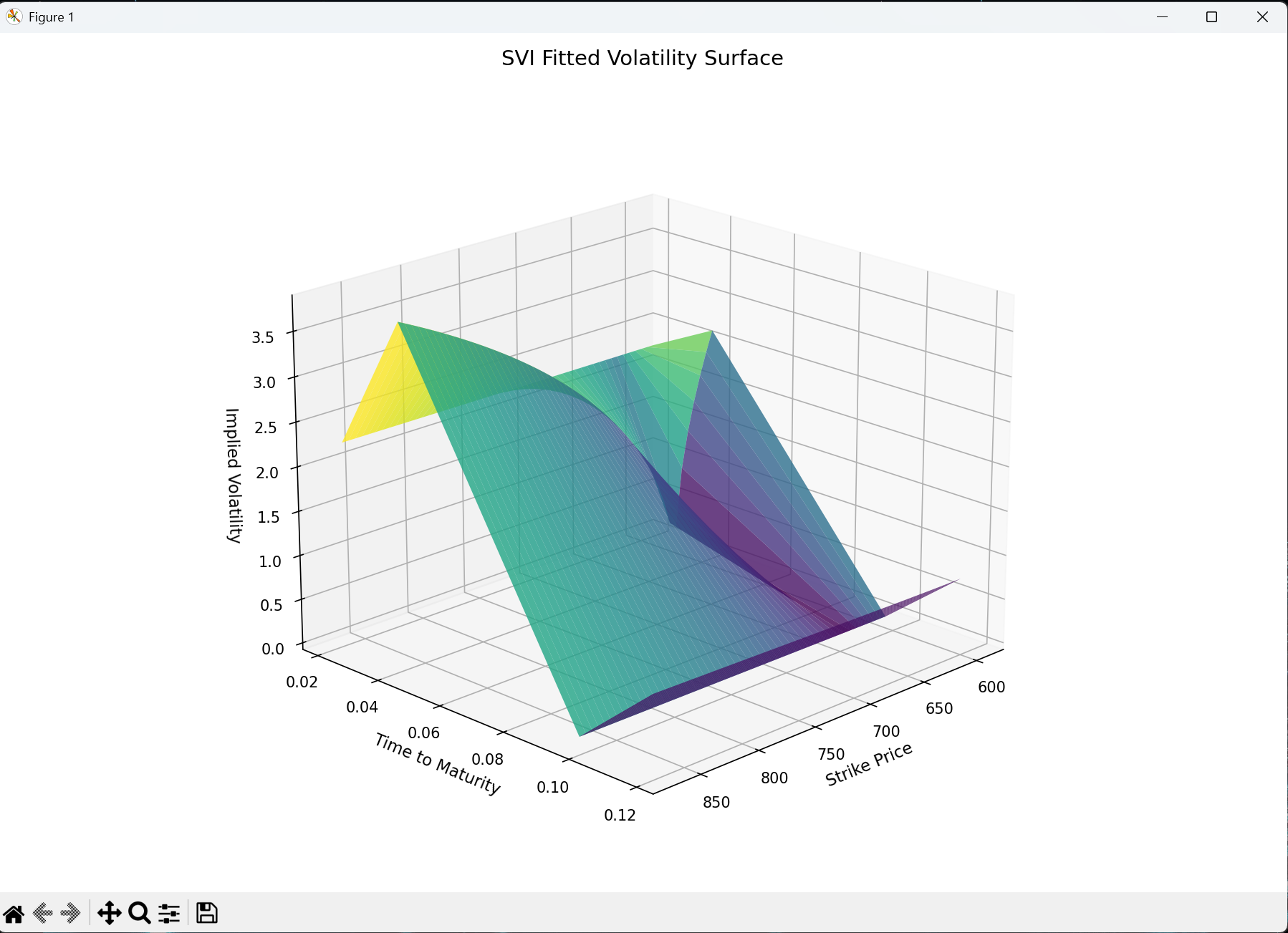
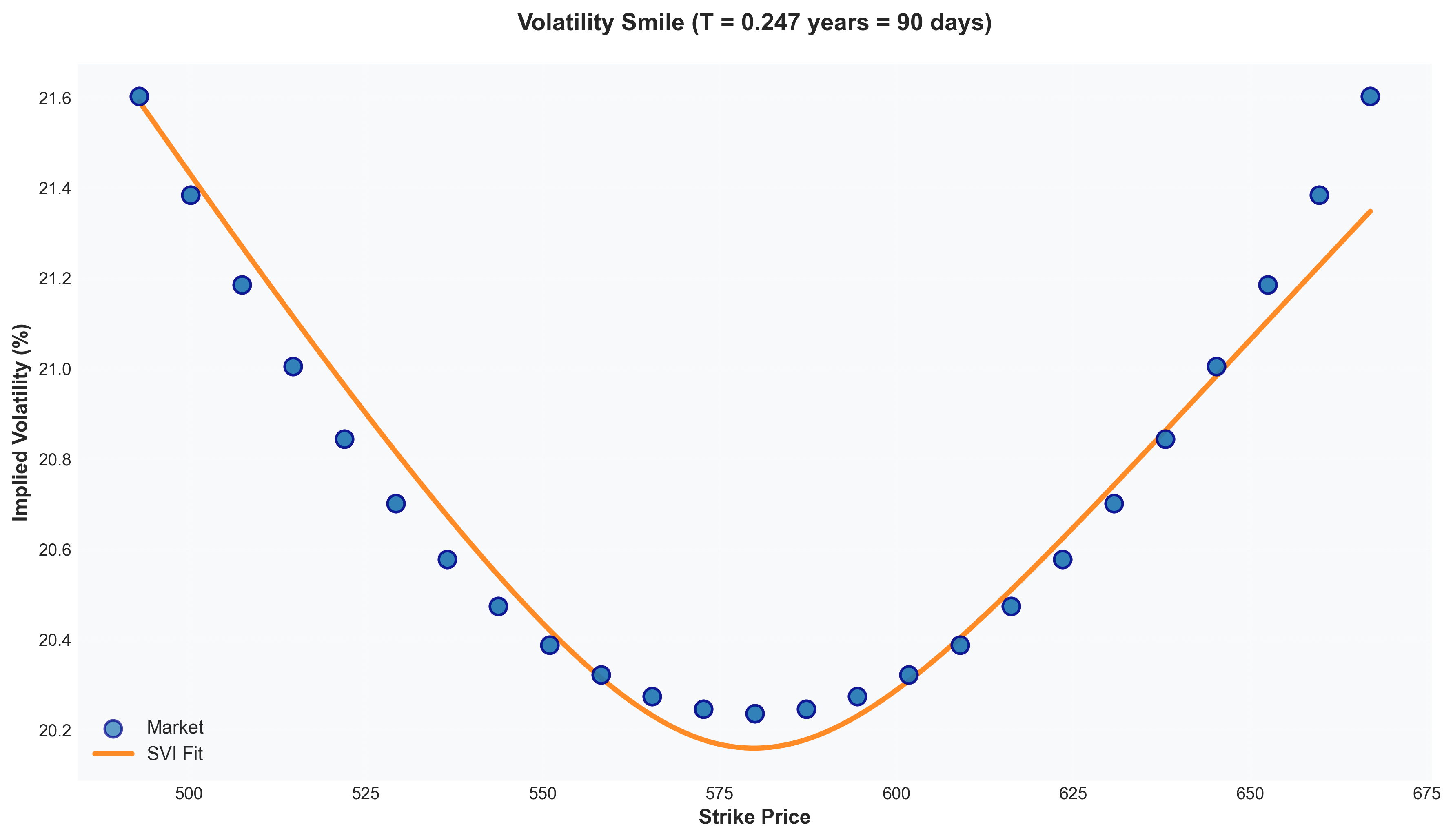
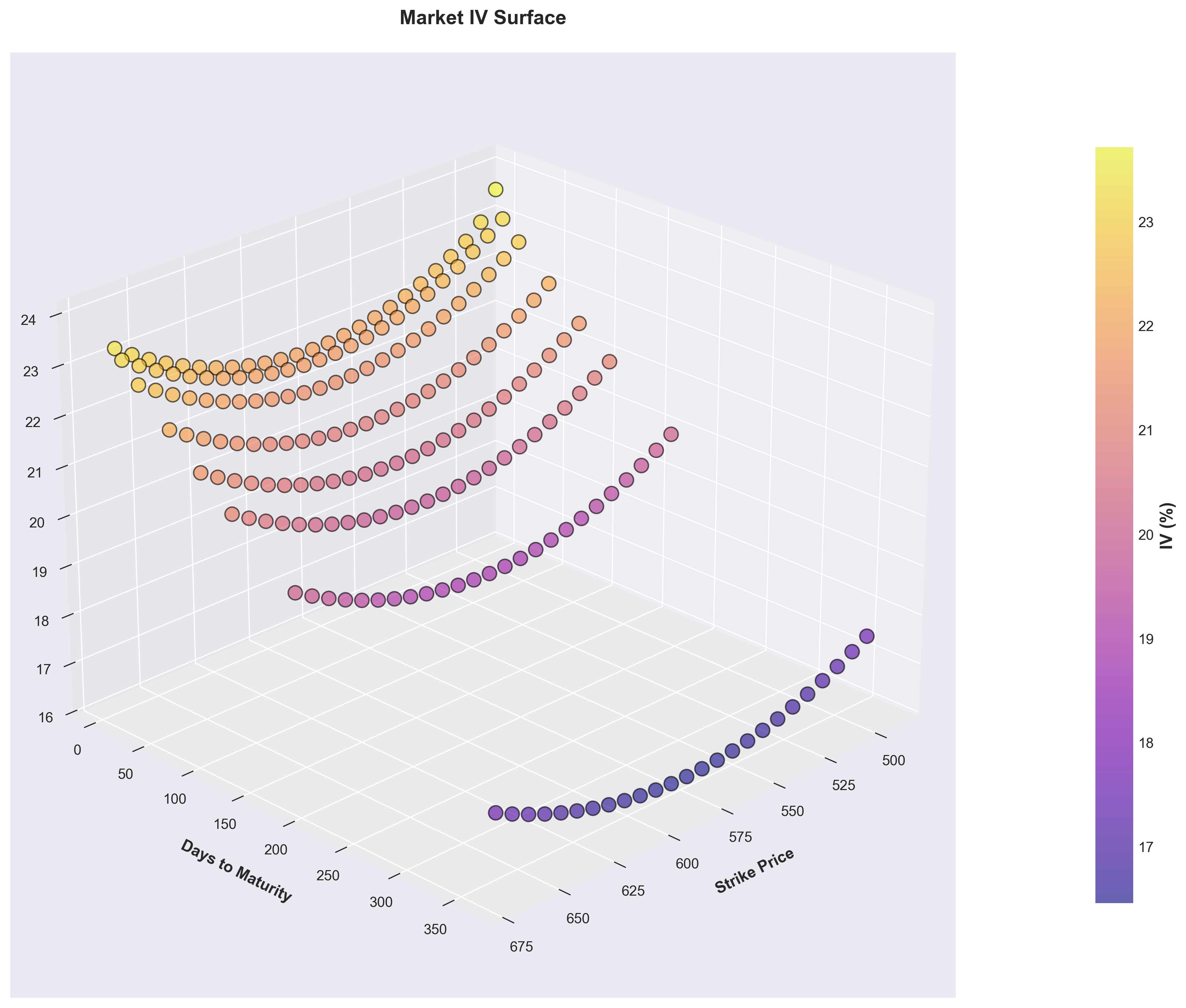
ASVS provides independent, composable modules for IV surface research. Load option data, compute implied volatilities with Newton-Raphson + Brent fallback, validate against arbitrage constraints (put-call parity, butterfly spreads, calendar), fit smooth SVI smiles with Gatheral no-arbitrage enforcement, and calibrate Heston parameters via COS pricing.
Each component includes robust error handling: Jaeckel rational approximation for deep OTM/ITM initial guesses, configurable arbitrage tolerance bands, Feller condition enforcement on Heston parameters, and multi-start optimization. Use the fluent API to chain operations or work with individual modules independently.
01 ——
IV Solver
Newton-Raphson + Brent fallback. Jaeckel (2015) rational approximation initial guess. Converges in ≤3 iterations for standard options.
02 ——
Arbitrage Check
Put-call parity, butterfly spreads, calendar arbitrage. Configurable tolerance. Reports violations by expiry/moneyness band.
03 ——
SVI Fitting
L-BFGS-B least-squares optimization. Gatheral no-arbitrage constraints enforced. Per-expiry calibration with rolling covariance.
04 ——
Heston Calib.
COS method (N=128 terms, exponential convergence). Feller condition enforced. Global + local multi-start optimization.
02 — Theory
Core
Methods
The toolkit implements three complementary methodologies. Black-Scholes IV inversion solves for implied volatility from market option prices. SVI parameterization provides a parsimonious, arbitrage-free representation of the volatility smile. The Heston stochastic volatility model captures dynamics and Greeks via characteristic function methods.
1 — Implied Volatility (Newton-Raphson)
Given market option price C_market, solve for σ in Black-Scholes:
C_BS(S, K, T, r, σ) = C_market
Newton-Raphson iteration using vega as the derivative:
σ_{n+1} = σ_n − (C_BS(σ_n) − C_market) / vega(σ_n)
Converges quadratically in ~3 iterations. Jaeckel (2015) rational approximation provides tight initial guess for deep OTM/ITM options.
2 — SVI Parameterization (Gatheral, 2014)
Total implied variance as a function of log-moneyness k = log(K/F):
w(k) = a + b(ρ(k − m) + √((k − m)² + σ²))
No-arbitrage conditions (Gatheral & Jacquier, 2014):
• b ≥ 0 • |ρ| < 1 • σ > 0
• a + bσ√(1 − ρ²) ≥ 0 • b(1 + |ρ|) ≤ 4
3 — Heston Stochastic Volatility Model
Risk-neutral asset and variance dynamics:
dS_t = rS_t dt + √(v_t)S_t dW¹_t
dv_t = κ(θ − v_t)dt + ξ√(v_t) dW²_t
Feller condition (strict positivity): 2κθ > ξ²
COS pricing achieves O(e^−N) convergence:
C(S, K, T) = e^−rT Σ Re(φ(kπ/(b−a)) · U_k · χ_k)
03 — Workflow
Analysis
Pipeline
ASVS provides a fluent API for end-to-end IV surface analysis. Chain operations from data ingestion through model fitting and visualization, or use individual modules as needed. All components are type-annotated, tested, and designed for research reproducibility.
01
Load Data
DataFrame with strike, expiry, option_type, price. Spot S, rate r.
02
Compute IVs
Newton-Raphson + Brent fallback. Intrinsic value floor.
03
Arbitrage Check
PCP, butterfly, calendar. Reports violations by band.
04
Fit SVI
L-BFGS-B, per-expiry, no-arb enforcement.
05
Calibrate Heston
COS pricing, Feller check, multi-start local/global.
06
Greeks & Analysis
Delta, vega, gamma surfaces. Finite diff or closed-form.
07
Visualize
3D surface, smile, term structure, Greeks heatmaps.
04 — Benchmarks
Performance
Profile
Typical runtimes on Intel i7 hardware. All components are vectorized and optimized for batch processing. COS pricing with N=128 terms achieves <10 μs per option.
Computation Time
IV compute (100 opts)
12 ms
SVI fit (50 × 5)
45 ms
Heston calib (250 opts)
1.2 s
COS pricing (1 option)
0.8 ms
Greeks (via finDiff)
6 ms
Test Coverage
Total Tests
108
Line Coverage
54%
IV Solver Tests
18
SVI Fitting Tests
24
Heston Calib Tests
22
06 — Features & Tools
Comprehensive
Toolkit
ASVS includes a complete suite of tools for volatility surface analysis: robust IV computation with fallback methods, arbitrage violation detection, SVI calibration with no-arbitrage enforcement, Heston stochastic volatility calibration, Greeks computation, and publication-quality visualizations.
| Component |
Method |
Feature |
Status |
| IV Solver |
Newton-Raphson |
Jaeckel initial guess + Brent fallback |
✓ |
| Arbitrage Check |
Put-Call Parity |
PCP violations, butterfly spreads, calendar |
✓ |
| SVI Fitting |
L-BFGS-B |
Per-expiry, Gatheral constraints, rolling covar |
✓ |
| Heston Calib |
COS Method |
Global + local multi-start, Feller enforced |
✓ |
| Greeks |
Finite Diff + Analytic |
Delta, gamma, vega, theta surfaces |
✓ |
| Term Structure |
Interpolation |
ATM vol, skew, term structure curves |
✓ |
| Visualization |
Matplotlib + Plotly |
3D surface, smile, Greeks heatmaps, comparison |
✓ |
| Model Compare |
RMSE / MAE |
Market vs SVI vs Heston error metrics |
✓ |
07 — Example
Research
Workflow
Build analysis pipelines with a clean, composable API. All methods return self for chainability. Type-annotated for IDE support and research reproducibility.
Minimal Usage Example
import pandas as pd
from vol_surface import VolatilitySurface
data = pd.DataFrame({
'strike': [95, 100, 105, 110],
'expiry': [0.25, 0.25, 0.25, 0.25],
'option_type': ['call', 'call', 'call', 'call'],
'price': [8.5, 5.2, 2.8, 1.1]
})
surface = VolatilitySurface(S=100, r=0.02)
surface.load_data(data) \
.compute_ivs() \
.check_arbitrage() \
.fit_svi() \
.calibrate_heston()
surface.plot_smile(expiry=0.25, include_svi=True)
surface.plot_surface_3d(model='heston')
surface.summary()
The library is open-source (MIT license) with comprehensive test coverage (108 tests). Designed for research, backtesting, and derivatives pricing applications. Includes example notebooks, API documentation, and benchmark scripts.